

Reviewed 2 September 2026. Sources checked the same day.
The short answer: do not leave a carbon monoxide alarm on the hearth beside a fire unless the instructions for that exact alarm and installation specifically permit it. For an alarm protecting a room with a combustion appliance, England’s Approved Document J gives a clear same room position: 1 to 3 metres horizontally from the appliance, and either on the ceiling at least 300mm from any wall, or high on a wall above doors and windows but at least 150mm below the ceiling. Always follow the alarm manufacturer’s instructions as well.
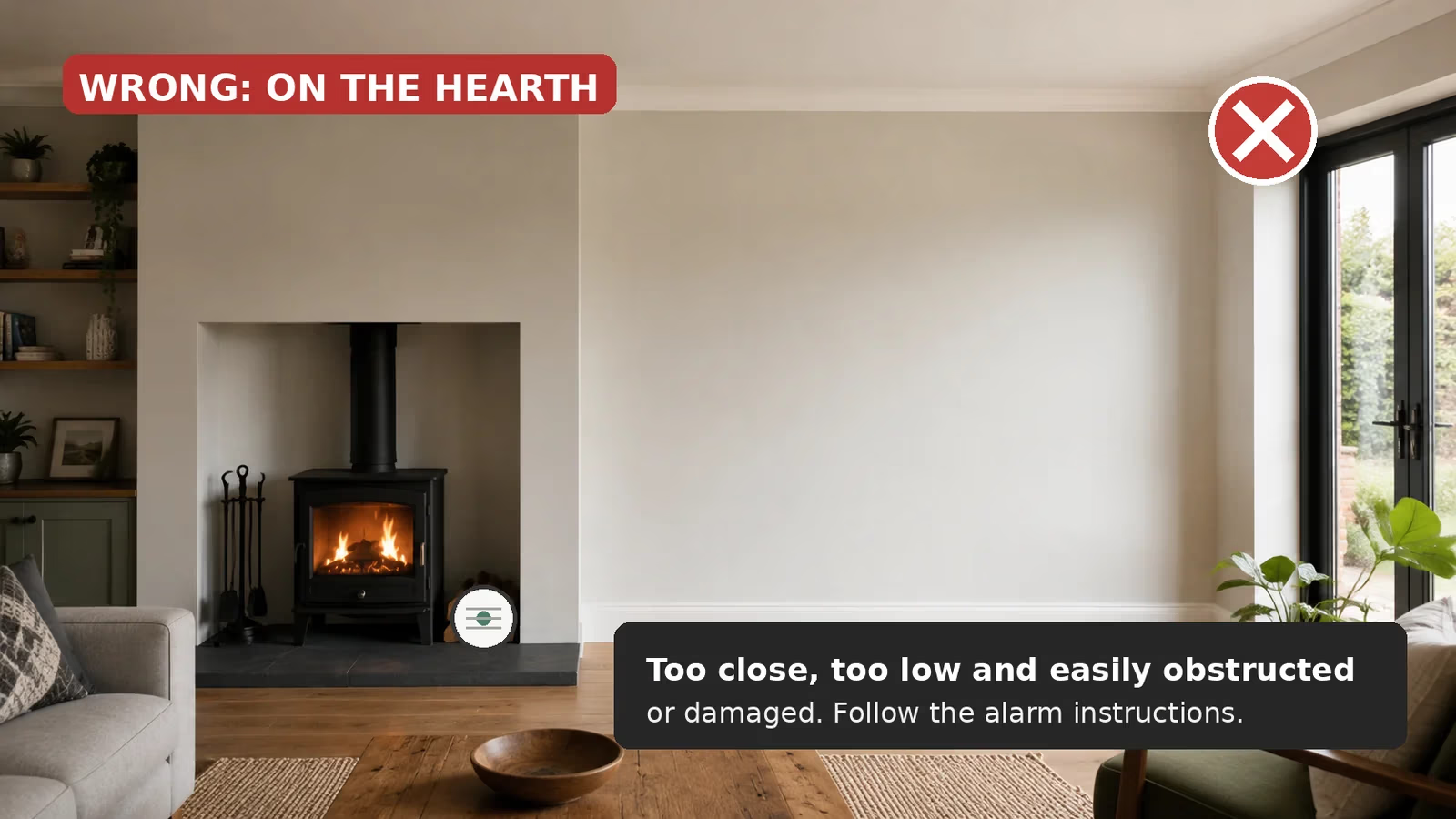
The dangerous mistake we keep finding
During home surveys, we regularly find a carbon monoxide alarm sitting loose on the hearth, sometimes only a few centimetres from a gas fire, log burner or open fire. The owner has done the right thing by buying an alarm, but the position can undermine the protection they expected from it.
A hearth level alarm is commonly too close to the appliance, outside the specified mounting position, exposed to heat, ash and dust, and easy to cover, knock over or remove. A freestanding alarm also cannot be assumed suitable for every shelf or surface: its instructions must expressly allow that installation method.
Do not simply move it higher because CO rises: that explanation is misleading. Carbon monoxide does not behave like smoke and does not reliably form a layer at the ceiling. In normal room conditions it mixes with the surrounding air. Correct positioning is based on tested distance, airflow, likely sources and the alarm design, not a simple rule that CO always rises.
Does carbon monoxide rise?
Carbon monoxide is very close to air in density. Heat from an appliance can initially carry combustion gases upwards, but room air currents, heating and ventilation then mix the gas. Research in a controlled chamber found that carbon monoxide did not form a dependable layer at the floor, middle or ceiling. That is why high because it rises and low because it sinks are both poor shortcuts.
The correct height depends on what the alarm is protecting against and how that model is designed to be installed. A same room alarm near a fire follows one set of positions. An additional alarm in a bedroom may be placed closer to the occupants’ breathing zone if its instructions permit it. Those are different jobs.
The correct position in a room containing a fire or stove
For new or replacement fixed solid fuel, gas or oil appliances in dwellings in England, Approved Document J says the alarm should be in the same room as the appliance. Its position should meet both of the following requirements.
| Position | Required clearance | What that means in practice |
|---|---|---|
| Either: ceiling mounted | At least 300mm from any wall | Keep it clear of corners, light fittings and obstructions, and still 1 to 3m horizontally from the appliance |
| Or: wall mounted | As high as possible, above doors and windows, but not within 150mm of the ceiling | Do not put it at skirting board or hearth height. Keep the sensor openings unobstructed |
| Both options | Between 1m and 3m horizontally from the appliance | Measure across the room, not up the wall or along a sloping line |
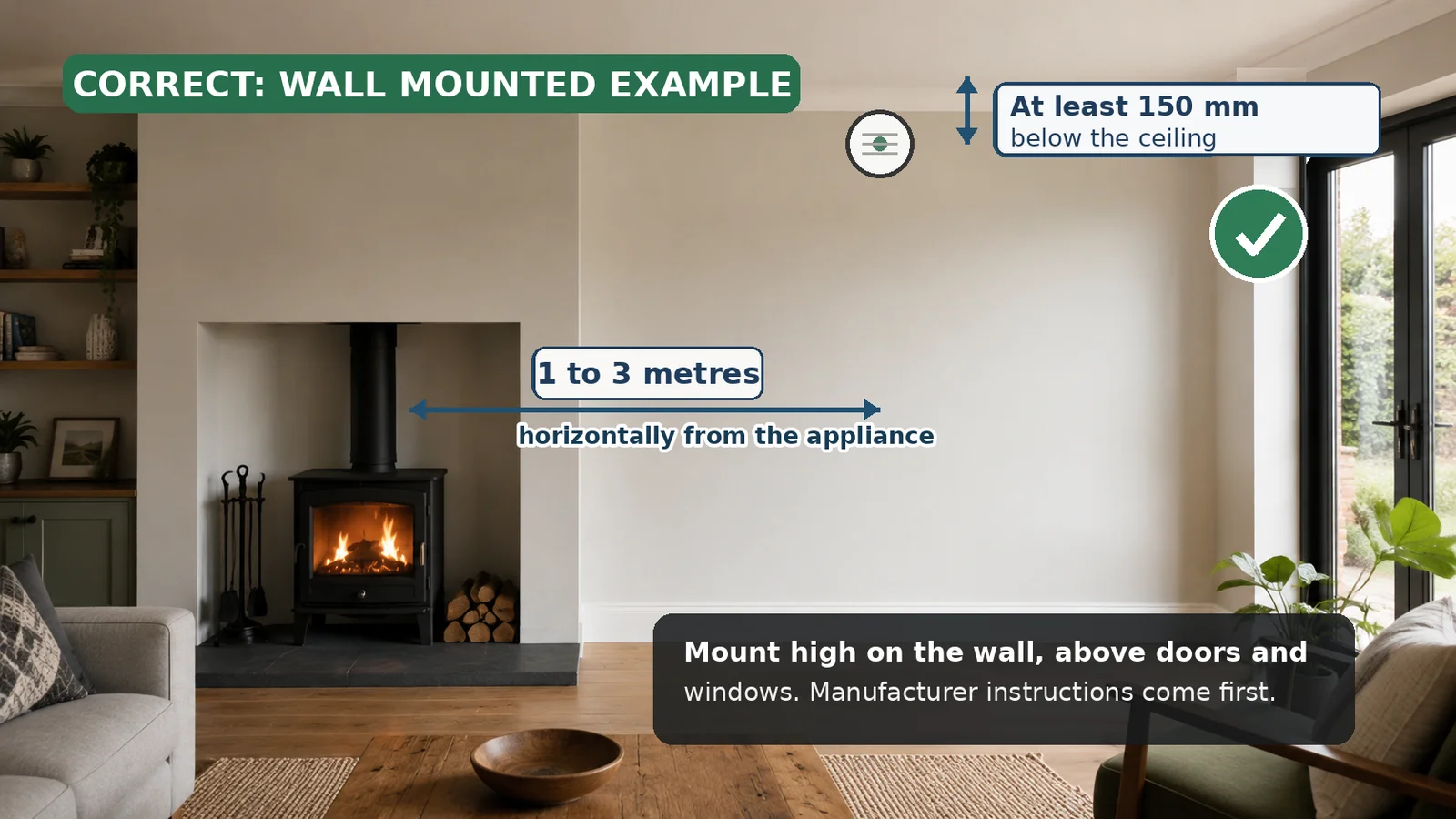
Source: Approved Document J, paragraphs 2.34 to 2.36, 3.43 to 3.45 and 4.30 to 4.32.
Why the alarm should not be directly beside or above the appliance
Placing an alarm immediately beside a fire ignores the 1 to 3 metre horizontal distance. Placing it directly over the appliance is not a solution either. Heat, localised combustion products and the strong air movement around the fire are not the conditions intended by the general positioning guidance. The alarm needs to sample the room air from a suitable location without being cooked, contaminated or blocked.
If the room layout makes the standard position difficult, for example a very small room, a sloping ceiling, a beam, an unusually high ceiling or several appliances, do not improvise. Check the model instructions and ask the installer, alarm manufacturer or a competent professional to confirm the position.
Places to avoid
- On the hearth, floor or skirting board next to the fire
- Closer than 1 metre or farther than 3 metres horizontally from the appliance when using the Approved Document J same room position
- Inside a cupboard, cabinet, fireplace recess or other enclosed space
- Behind curtains, furniture, pictures or shelving where air cannot reach the sensor freely
- Next to a door, window, extractor fan, air vent or similar opening where draughts may delay or dilute the sample
- Directly above a sink, or where steam, grease, aerosols or condensation can contaminate it
- Where the alarm may be exposed to temperatures outside its stated operating range
- Any position prohibited by the alarm manufacturer
Source: Kidde UK on alarm position, exclusions, cleaning and testing.
What about bedrooms and the rest of the house?
The priority is an alarm in every room containing an appliance that burns gas, oil, coal or wood. The NHS recommends one in each such room. Additional alarms can improve warning in rooms where people spend considerable time and near sleeping areas. If a flue passes through another room, guidance also recommends considering an alarm there.
Bedroom positioning is different from the diagram above. For an additional bedroom alarm, industry guidance based on BS EN 50292 (FireAngel publishes a useful positioning guide) places it relatively close to the occupants’ breathing zone. Use only a model approved for the proposed wall, ceiling or freestanding position and follow its manual. A bedside shelf allowed by one model does not make the hearth beside a fire an acceptable position for another.
Choose an alarm made for the job
For building work covered by Approved Document J in England, the guidance specifies alarms complying with BS EN 50291-1:2018. It describes a lifetime battery with an end of life warning, or a suitable fixed wired Type A alternative with a sensor failure warning. A cheap unverified gadget, an app notification on its own or a smoke alarm without a CO sensor is not a substitute.
- Look for BS EN 50291-1 on the product or documentation and buy from a reputable supplier
- Check whether the model is approved for wall, ceiling, shelf or travel use. Do not assume every round alarm is installed like a smoke alarm
- Choose an alert that everyone in the home can perceive. People who are deaf or hard of hearing may need linked vibrating pads, strobes or other specialist warning devices
- Record the installation date and the replace by or end of life date where you can find it later
An alarm is a last line of warning: it does not make an unsafe fire, stove, boiler, flue or chimney safe. Correct installation, adequate ventilation, chimney sweeping and regular servicing remain essential.
How to maintain a carbon monoxide alarm
An alarm spends most of its life appearing to do nothing. A simple routine helps ensure that it is powered, unobstructed and still within its service life.
- Read and keep the instructions. Alarm sounds, test intervals, battery arrangements and cleaning methods differ by model
- Press the test button at the interval stated by the manufacturer. Many leading manufacturers specify weekly testing. Check that every person who needs to hear the alarm can do so from bedrooms and usual living areas
- Keep the sensor openings clear. Gently dust or vacuum the outside at the interval and by the method in the manual. Kidde advises cleaning or dusting at least monthly
- Never paint the alarm or spray polish, air freshener, insecticide, cleaner or aerosol near it. Do not immerse it in water or cover it for decoration and forget to uncover it
- Respond to low battery, fault and end of life warnings. Replace a user replaceable battery only with the specified type. Replace a sealed battery alarm as a complete unit when instructed
- Replace the whole alarm by its marked replace by date or end of life signal. Typical product lives are often 7 to 10 years, but the date on the alarm and its manual, not a general average, decide when yours must go
- Test after installation, after approved battery replacement and after work that may have moved, covered or contaminated the alarm
What not to do when testing or cleaning
- Do not test a domestic alarm with car exhaust, a barbecue, a cigarette, a candle or an open flame. Use the test button and any manufacturer approved sensor test procedure
- Do not use solvents, detergents or abrasive cleaners unless the instructions expressly allow them
- Do not remove batteries because of nuisance chirping. Identify the signal from the manual and correct the fault or replace the unit
- Do not rely on a digital display reading zero as proof that the alarm is working. Use the specified test procedure
What to do if the alarm sounds
Treat every CO alarm as real: do not silence it and stay in the room while you search for a cause. Stop using suspected appliances if you can do so safely, get everyone into fresh air and seek the appropriate emergency and medical advice.
- Leave the affected building and move into fresh air. Help children, older people, pets and anyone with mobility needs
- If it is safe and quick, switch off the suspected appliance. Do not delay leaving to investigate or dismantle anything
- If a gas appliance may be involved, call the National Gas Emergency Service on 0800 111 999, a freephone number. The line is open 24 hours a day
- Call NHS 111 if you think anyone has symptoms of carbon monoxide poisoning. Call 999 or go to A&E for breathing difficulty, sudden confusion, loss of consciousness, weakness, or chest or muscle pain. Do not drive yourself to A&E
- Do not go back into the building until you have received advice. Do not use the appliance again until the cause has been found and made safe by a competent person
Sources: NHS on symptoms and action after suspected exposure and HSE on what to do if an appliance may be spilling carbon monoxide.
Know the warning signs, but never wait for them
Carbon monoxide has no colour, smell or taste. Possible symptoms include headache, dizziness, nausea, weakness, tiredness, confusion, chest or muscle pain and shortness of breath. Symptoms may improve when you leave the building and return when you go back inside. Soot or staining, unusual condensation and pilot lights going out can indicate poor combustion (our guide on why gas fire glass discolours explains what soot on the glass means), but CO can be present without an obvious visible sign.
What does the law require in England?
Two different duties are relevant and should not be confused. Approved Document J gives building regulation guidance when a new or replacement fixed combustion appliance is installed in a dwelling. Since 1 October 2022 this includes fixed solid fuel, gas and oil appliances within its scope, with gas appliances used solely for cooking excluded.
Separately, the Smoke and Carbon Monoxide Alarm (Amendment) Regulations 2022 require relevant private and social landlords in England to provide a CO alarm in any room used as living accommodation that contains a fixed combustion appliance, excluding gas cookers. Landlords must repair or replace a faulty alarm once informed and the fault is found. The rented home regulations do not prescribe the exact position, so official guidance says to follow the manufacturer’s instructions.
Rules differ across Scotland, Wales and Northern Ireland. This article uses the current England position because Heatwave is based in Warrington. Landlords and installers elsewhere should check the rules for their nation.
Our verdict
Buying a carbon monoxide alarm is only half the job. Leaving it on the hearth beside the fire may put it too close to the source, too low, exposed to dirt and easy to obstruct. Move it to a position that complies with the product instructions and the relevant installation guidance.
The memorable rule for a wall mounted same room alarm is: high on the wall, above doors and windows, at least 150mm below the ceiling and 1 to 3 metres horizontally from the appliance. For a ceiling mounted alarm: at least 300mm from a wall and still 1 to 3 metres horizontally from the appliance. Measure the actual room, do not judge it by eye.
Frequently asked questions
Should a carbon monoxide alarm be high or low?
In a room containing a combustion appliance, Approved Document J supports either a ceiling position at least 300mm from a wall or a high wall position above doors and windows but at least 150mm below the ceiling. Both should be 1 to 3m horizontally from the appliance. Additional bedroom alarms may follow different breathing zone guidance, so use the model instructions.
Does carbon monoxide rise to the ceiling?
Not in the simple way smoke does. CO is close to air in density and mixes through normal room air currents. Correct alarm position is based on tested clearances, airflow, source distance and the alarm design.
Can I put my CO alarm on the hearth?
A hearth beside a fire is usually the wrong position: commonly too close, too low and vulnerable to heat, ash, obstruction and damage. Only use a freestanding position expressly allowed by the alarm instructions, and still meet the required source distance.
How far should a carbon monoxide alarm be from a log burner or gas fire?
For the same room wall or ceiling position in Approved Document J, it should be between 1m and 3m horizontally from the appliance.
Can a carbon monoxide alarm go on the ceiling?
Yes, if the model is approved for ceiling mounting. Approved Document J says at least 300mm from any wall and 1 to 3m horizontally from the appliance.
How often should I test my CO alarm?
Follow the manufacturer’s instructions. Many manufacturers specify weekly testing using the test button. Do not improvise with exhaust fumes or a flame.
How long does a CO alarm last?
Many current alarms have a service life of roughly 7 to 10 years, but models vary. Replace yours on its marked date, end of life warning or the interval in its manual.
What should I do if my carbon monoxide alarm goes off?
Get everyone into fresh air, stop the suspected appliance only if safe, and seek help. Call 0800 111 999 if gas may be involved, NHS 111 for suspected symptoms, and 999 for severe symptoms or immediate danger. Do not reuse the appliance until it has been checked.
Need advice about your fire, stove or alarm position?
Visit Heatwave Fireplaces at Osnath Works, Lythgoes Lane, Warrington, WA2 7XE. Bring a photograph showing the appliance, full wall and ceiling, together with the alarm make and model. We can explain the likely installation position and, where necessary, direct you to the appropriate competent installer or manufacturer guidance. Getting ready for the colder months? Our winter fireplace checklist covers the other safety jobs worth doing now, and our stove range and gas fires are all on display in the showroom. Call 01925 230045.
This article provides general customer guidance for a typical domestic installation. The alarm instructions, appliance instructions, applicable building regulations and an on site assessment take priority.
Sources used for this article
- GOV.UK: Approved Document J for England
- GOV.UK: landlord and tenant alarm guidance for England
- HSE: carbon monoxide awareness
- NHS: carbon monoxide poisoning
- Kidde UK: CO alarm positioning and maintenance
- Hampson and Weaver: detector placement study
- FireAngel: CO alarm positioning guidance (manufacturer knowledge hub)